
Audit every UK and EU entry against the documents that already exist
Three parallel audits on every entry: the original declaration, the returns recovery opportunity and the regime overlays. CDS and AES reconciliation. Returned Goods Relief, Customs Drawback, IPR/OPR, CBAM and Customs Warehousing. One data set. One reconciled view.
This document defines the scope of a UK and EU customs compliance engagement. It explains what we audit, how we audit it, what documents we ingest and what we deliver. It does not constitute legal advice.
UK and EU importers face overlapping compliance obligations
Post-Brexit divergence means UK and EU customs regimes now operate independently. An importer trading across both faces CDS in the UK, AES in the EU, separate preference rules, separate recovery mechanisms and separate audit windows. Most declarations cleared correctly at the time are sitting on duty exposure today.
One workflow. Three audits. Every entry.
The three audits run in parallel against the same data set. A finding in one layer almost always surfaces a recovery or exposure in another. The original declaration audit feeds the returns analysis. The returns analysis informs the regime overlay reconciliation.
We reconcile every field on the CDS entry (UK) or SAD/AIS declaration (EU) against the commercial invoice, bill of lading, certificate of origin and packing list. Where a commodity code, customs value, origin, preference claim or procedure code does not match the source document, we raise a finding.
This is not a sample audit. Every electronic entry in the engagement period passes through the same reconciliation. Findings are categorized as overpayment, underpayment, classification risk or data discrepancy. The EORI is the unifying key. We audit every declaration filed against your identifier, across every broker.
Goods that have been exported and re-imported, or imported and subsequently returned, may qualify for duty relief. We reconcile the import declaration against the export MRN, regardless of which broker handled each leg. The same data set that drives Layer 1 feeds the returns analysis.
UK: Returned Goods Relief under Customs Notice 236 with a 3-year window. EU: RGR under UCC Article 203 with a 3-year window. Critical from 1 July 2026 as de minimis closes. Customs Drawback under UK CN 998 (3 years) and EU UCC Article 238. C285 repayment claims prepared where duty was overpaid.
Beyond the core declaration and returns audit, several regulatory regimes create additional compliance obligations and recovery opportunities. Each overlay runs against the same reconciled data set.
CBAM: Carbon Border Adjustment Mechanism applies to EU imports of cement, iron & steel, aluminium, fertilisers, electricity and hydrogen. We identify entries in scope and prepare emissions data for quarterly and annual reporting.
AES Reconciliation: Export declarations reconciled against import entries to verify quantity, value and commodity code consistency. Critical for RGR and IPR discharge.
IPR/OPR: Inward and Outward Processing Relief authorisations require discharge within the authorised period. Undischarged IPR creates significant retrospective duty liability. We reconcile imports under IPR against the corresponding exports.
Customs Warehousing: Goods held under customs warehousing procedures must be discharged correctly. We audit warehouse entries against removals, transit movements and re-export declarations.
Document-first. Entry-level. Every line.
We do not start from the tariff schedule. We start from the shipping documents: the commercial invoice, the bill of lading, the certificate of origin, the packing list and the CDS entry or SAD filed by the broker.
FastNet™, our document-extraction engine, ingests and normalises these documents into a structured data set. Every field on the declaration is then reconciled against the source documents. Where a field does not match, a finding is raised.
This approach is deliberately conservative. We do not reclassify. We do not revalue. We reconcile what was declared against what the documents say. The result is a set of findings that are defensible because they are grounded in the importer's own paperwork.
Once the reconciliation is complete, the returns recovery and regime overlay layers run against the same data set. The output is a single dashboard with three views: original declaration findings, returns recovery and regime overlay exposure.
Five documents. The same across UK and EU.
This is the complete list of documents we ingest for a UK/EU customs audit. We do not request ERP data, accounting records or internal pricing files.
| Document | Source | Key Fields Extracted | Used In |
|---|---|---|---|
| CDS Entry (UK) / SAD (EU) | Customs agent or broker / CDS / AES | Entry number, commodity code, value, duty, origin, quantity, procedure code, preference | All three layers |
| Commercial Invoice | Seller / exporter | Unit price, total value, product description, Incoterms, currency | Layer 1 (value reconciliation) |
| Bill of Lading / CMR | Carrier / freight forwarder | Shipper, consignee, port of lading, port of discharge, weight, container | Layer 1 (origin & routing verification) |
| Certificate of Origin / EUR.1 | Exporter / chamber of commerce | Country of origin, manufacturer, preferential treatment indicator, FTA reference | Layers 1 & 2 (preference, RGR eligibility) |
| Packing List | Seller / exporter | Quantity, weight per item, package count, product breakdown | Layer 1 (quantity & weight reconciliation) |
| Export MRN / AES Declaration | Exporting broker / AES / CHIEF-CDS | Export MRN, commodity code, value, quantity, destination | Layers 2 & 3 (RGR, IPR/OPR discharge, AES reconciliation) |
Six paths from finding to recovery
MyCustomsInfo® identifies the finding and quantifies the amount. The recovery action is filed by your customs agent or representative.
| Route | Authority | When Used | Deadline | Filed By |
|---|---|---|---|---|
| UK Returned Goods Relief | Customs Notice 236 | Goods re-imported to UK within 3 years of export, in unaltered state. | 3 years from export | Customs agent |
| EU Returned Goods Relief | UCC Article 203 | Goods re-imported to EU within 3 years of export, in unaltered state. | 3 years from export | Customs representative |
| UK Customs Drawback | Customs Notice 998 | Goods re-exported or destroyed. Import duty refund. | 3 years from import | Customs agent |
| EU Customs Drawback | UCC Article 238 | Goods re-exported or destroyed. Duty refund on import duties paid. | 3 years from acceptance | Customs representative |
| C285 Repayment (UK) | UCC Art. 116–119 (retained) | Duty overpaid, collected in error, or goods defective. | 3 years from notification | Customs agent |
| EU Repayment / Remission | UCC Art. 116–119 | Duty overcharged or collected in error across EU member states. | 3 years from notification | Customs representative |
Four regime overlays. Each with its own audit trail.
Beyond the core declaration and returns audit, four regulatory regimes create additional compliance obligations. Each runs against the same reconciled data set that powers Layers 1 and 2.
CBAM
Carbon Border Adjustment Mechanism under Regulation (EU) 2023/956. Definitive phase from January 2026. Applies to cement, iron & steel, aluminium, fertilisers, electricity and hydrogen. MyCustomsInfo® identifies entries in scope, prepares embedded emissions data and structures the quarterly and annual reporting package. Your authorised CBAM declarant submits.
IPR (Inward Processing Relief)
Goods imported under IPR authorisation must be discharged within the authorised period by re-export or release to free circulation. Undischarged IPR creates significant retrospective duty liability. MyCustomsInfo® reconciles imports under IPR procedure codes against the corresponding export declarations to identify undischarged quantities.
OPR (Outward Processing Relief)
Goods temporarily exported for processing and re-imported with relief on the value added abroad. MyCustomsInfo® reconciles the export declaration against the re-import entry to verify that the OPR procedure code, value differential and commodity code are correctly applied.
Customs Warehousing
Goods held under customs warehousing procedures (71xx/07xx) must be discharged correctly via re-export, release to free circulation or transit. MyCustomsInfo® audits warehouse entries against removals, transit movements and re-export declarations to identify undischarged inventory and duty exposure.
Same methodology. Different systems.
The three-layer model applies identically in both jurisdictions. The customs systems, legislative references and filing mechanisms differ.
| Element | United Kingdom | European Union |
|---|---|---|
| Declaration system | Customs Declaration Service (CDS) | AES / national import systems (AIS) |
| Tariff schedule | UK Global Tariff (UKGT) | Combined Nomenclature (CN) / TARIC |
| Returned Goods Relief | Customs Notice 236 | UCC Article 203 |
| Drawback | Customs Notice 998 | UCC Article 238 |
| Repayment claims | C285 form | National authority application under UCC Art. 116 |
| IPR/OPR | UK retained UCC provisions | UCC Art. 211–258 |
| CBAM | UK CBAM under consultation | Regulation (EU) 2023/956, definitive from Jan 2026 |
| De minimis | £135 threshold (by March 2029) | €150 closing 1 July 2026 (€3 interim) |
| EORI | UK EORI (GB prefix) | EU EORI (member state prefix) |
What MyCustomsInfo® does. What MyCustomsInfo® never does.
MyCustomsInfo® operates as an independent compliance auditor. We audit the data. Your customs agent or representative handles every corrective filing.
What MyCustomsInfo® Does
- ✓ Ingest and structure customs and shipping documents
- ✓ Reconcile CDS/AES declarations against source documents
- ✓ Identify overpayments, underpayments and classification errors
- ✓ Quantify RGR, Drawback and repayment eligibility per entry
- ✓ Reconcile IPR/OPR discharge against export declarations
- ✓ Prepare CBAM reporting data for in-scope entries
- ✓ Deliver findings in a structured dashboard and PDF report
What MyCustomsInfo® Never Does
- ✗ File, prepare or submit any document to HMRC or EU customs
- ✗ Determine or confirm a commodity code classification
- ✗ Submit a C285 repayment claim or EU repayment application
- ✗ File or manage IPR/OPR authorisations or discharge
- ✗ Submit CBAM declarations to the EU registry
- ✗ Provide legal advice
- ✗ Guarantee any classification, valuation or outcome
Every corrective action sits with your customs agent. MyCustomsInfo® identifies the finding. Your customs agent or representative determines the appropriate corrective action and files the relevant document with HMRC or the EU national customs authority. We audit. You act.
What you receive at the end of each audit cycle
Reconciliation Dashboard
Live, filterable view of every entry, every finding and every discrepancy. Drill from summary to entry line. UK and EU in one view.
PDF Audit Report
Formal findings report suitable for board presentation, external audit and agent instruction. Per-jurisdiction breakdown.
Recovery Schedule
Entry-by-entry quantification of RGR, Drawback and repayment eligibility with the applicable route and deadline.
Exposure Register
Entry-by-entry list of underpayments, IPR discharge gaps and classification risks requiring corrective action.
Agent Data Pack
Structured data extract formatted for your customs agent to file C285s, RGR claims or IPR corrections without re-keying.
Regime Overlay Summary
CBAM in-scope entries, IPR/OPR discharge status, Customs Warehousing reconciliation and AES export matches.
Engagements typically range from £6,000 to £40,000 per audit cycle for the three-layer scope, depending on declaration volume and jurisdictional coverage. Full pricing on the EU Pricing page.
As an indicative benchmark, importers with £5M to £20M annual duty paid have historically surfaced 2–4% in audit findings, of which 30–60% is recoverable under RGR, Drawback and C285 routes.
See how the three layers work. Then book a review.
Three dashboard views. Each corresponds to one audit layer. The same reconciliation engine, the same data set, three different compliance dimensions.
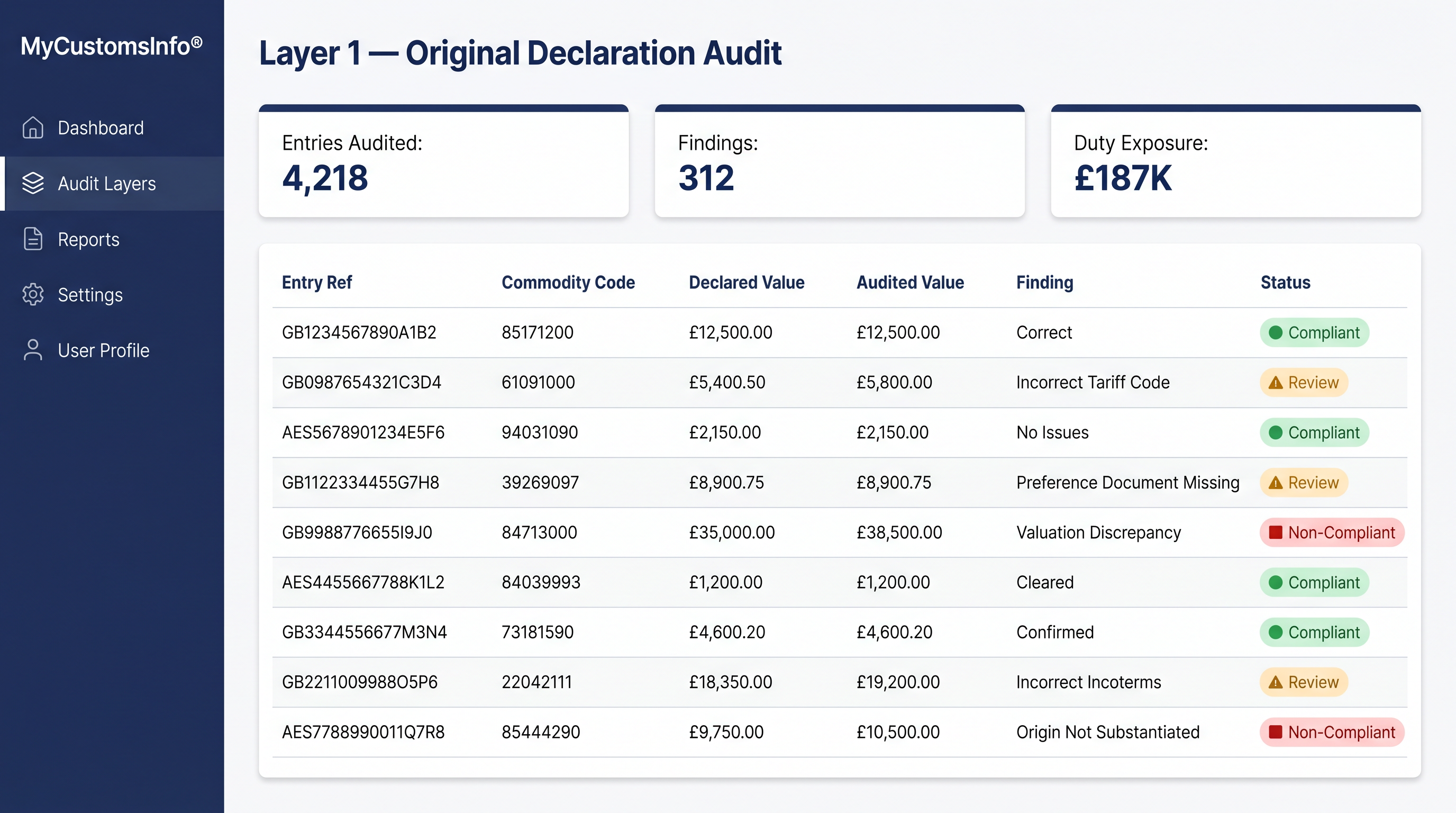
Layer 1: Original Declaration Audit
Every CDS and AES entry reconciled against the commercial invoice, packing list and certificate of origin. Classification errors, valuation discrepancies and preference under-utilisation flagged per entry.
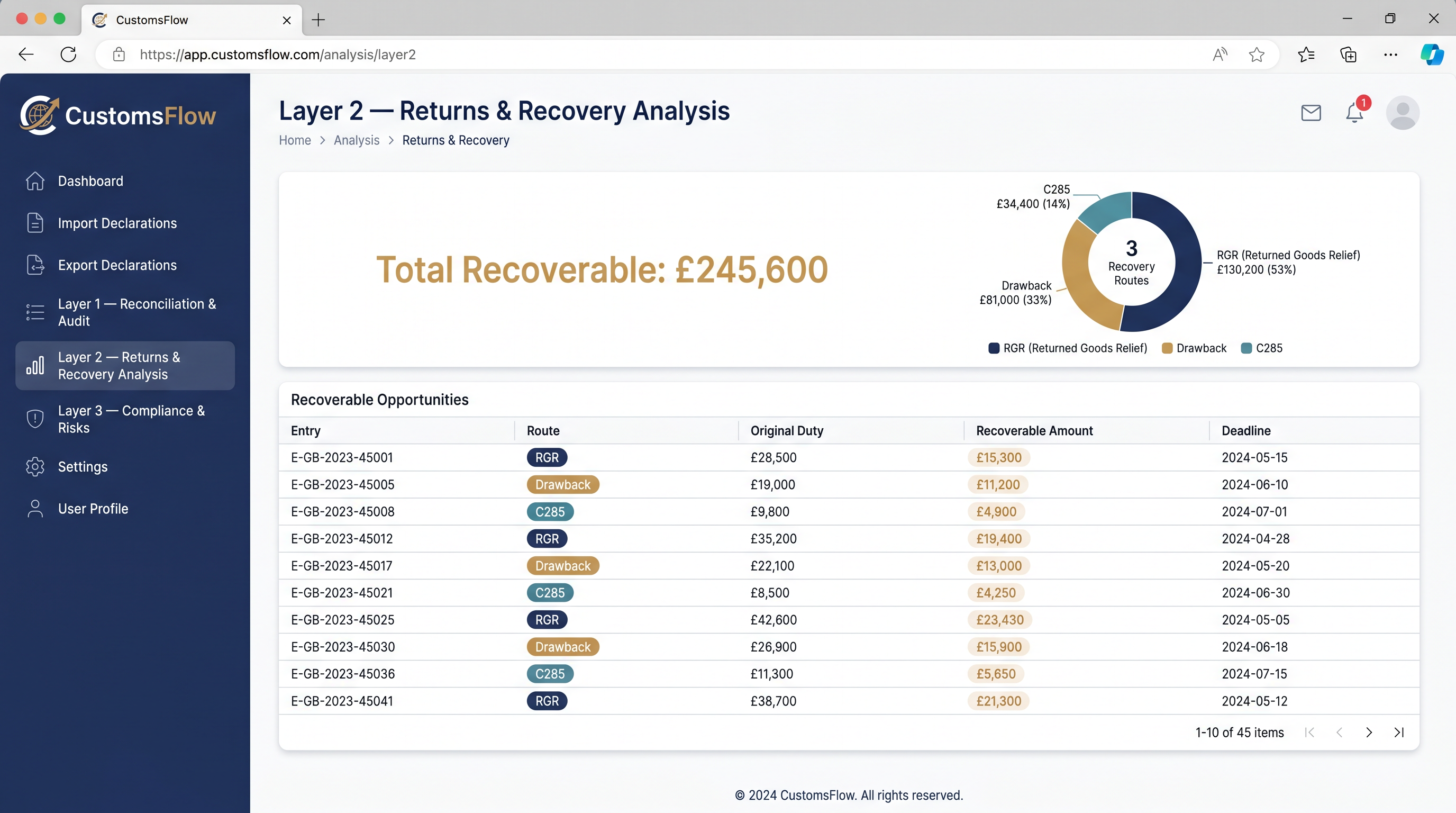
Layer 2: Returns & Recovery Analysis
Returned Goods Relief, Customs Drawback and C285 repayment opportunities identified per entry. Each recovery route quantified with the applicable deadline and correction mechanism.
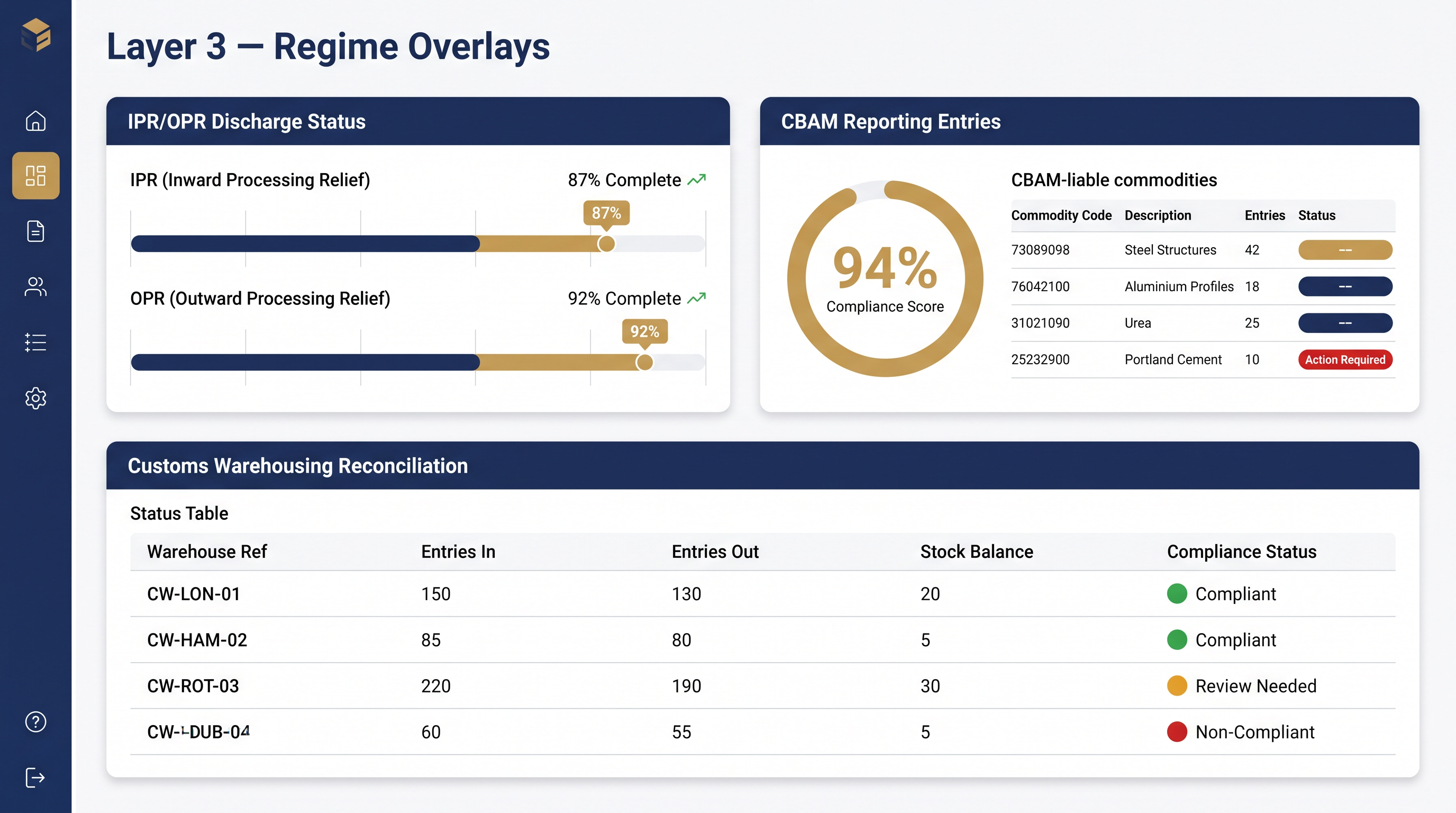
Layer 3: Regime Overlays
IPR/OPR discharge reconciliation, CBAM in-scope entry identification and Customs Warehousing stock balance verification. Each overlay runs against the same data set as Layers 1 and 2.
30-Minute Compliance Review
Walk through the three-layer methodology with a senior compliance analyst. We will show you the dashboard on a demonstration dataset, discuss your declaration volume and jurisdiction mix, and scope a tailored engagement.
- 30 minutes, no preparation required
- Demonstration dataset, not your data
- Tailored scope and pricing within two working days
Sample Audit on Your Own Entries
We run the full three-layer audit on a sample of your recent UK or EU entries and return the dashboard, the findings and the recovery schedule within five business days. Available under a signed short-form NDA and Data Processing Agreement.
- NDA and DPA before any document inflow
- Isolated sample audit tenant, AWS KMS encrypted
- Thirty-day retention, then verified destruction